

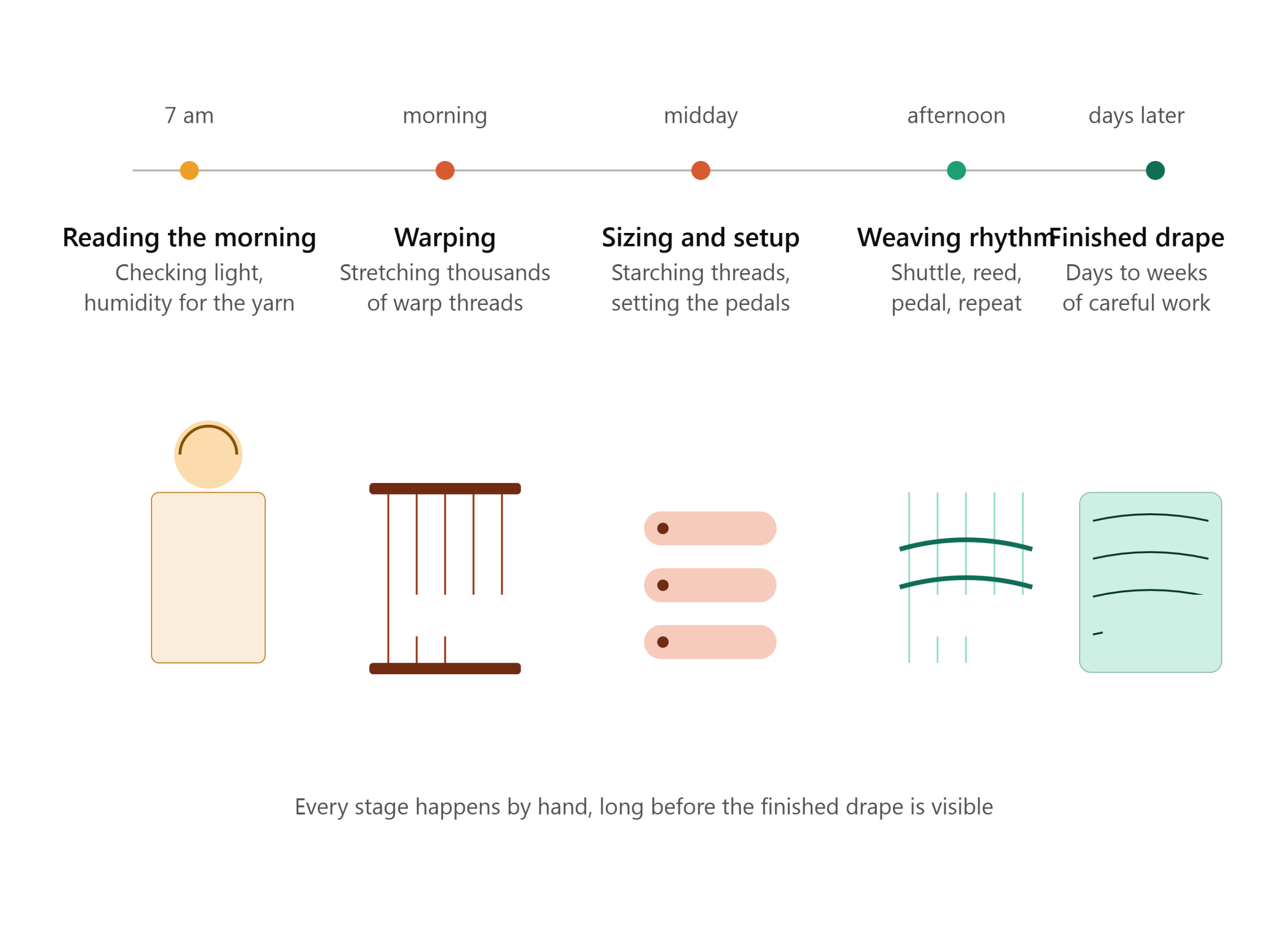
A handwoven saree doesn’t begin at the loom — it ends there. Days or even weeks of preparation go into that single piece of cloth long before a weaver sits down to actually weave. Most of that work stays invisible to anyone who only sees the finished product.
Reading the Morning
A typical day starts early, often before 7 AM, when natural light is good and humidity sits at a level that’s kind to the yarn. Cotton and silk threads are both sensitive to moisture. Too dry, and they snap under tension. Too damp, and they lose tension on the loom, causing uneven weaving.
Most experienced weavers we work with read these conditions almost instinctively. They adjust their pace and technique to the day’s weather without consciously thinking about it. Nobody writes this expertise down — weavers pass it on entirely through years of hands-on practice.
The Work Before the Weaving
Before the actual weaving begins, weavers handle warping: stretching hundreds, sometimes thousands, of individual warp threads across the full length of the loom in the exact sequence the pattern requires. A complex design can take a full day or more just for this step. Any error here shows up as a flaw across the entire length of fabric, not just one section.
Sizing comes next. Weavers starch the threads to reduce friction and prevent fraying as the shuttle passes through them thousands of times during weaving. For patterned weaves, they also set up the loom’s foot pedals or, in some cases, a jacquard attachment. Each mechanism needs precise configuration to lift the correct combination of threads at the correct moment, for every single pick of the weft thread.
The Rhythm of Weaving
Only after all this preparation does the actual weaving begin. The weaver throws the shuttle across the width of the fabric, beats the newly placed weft thread firmly into position with a reed, and shifts the foot pedals to prepare for the next pick. This motion looks deceptively repetitive, but it repeats, essentially unchanged, for every few millimetres of finished cloth — hour after hour.
A relatively simple, unpatterned cotton saree might take a weaver 3 to 5 days of dedicated weaving time to complete. A heavily patterned silk saree — a Kanjivaram with elaborate temple motifs, or a Baluchari with a full narrative pallu — can take several weeks of continuous, careful work.
Why the Effort Matters
This slow, physically demanding labour requires sustained concentration for hours at a time. Call it a wrist, shoulder, and back workout disguised as craftsmanship. It’s also the only reason a genuinely handwoven textile carries the texture, drape, and quiet, almost imperceptible irregularity that make it recognisably handmade rather than machine-produced.
A power loom repeats a pattern with mechanical precision. A human weaver repeats it with skilled, careful, but never quite mechanical precision — and that tiny human variation gives handloom fabric its particular character.
No Single “Typical” Day
This daily rhythm varies considerably by region and by weave. A weaver working on a simpler, unpatterned cotton in Tamil Nadu might finish their daily quota by early afternoon, leaving time for household or agricultural work many weaving families still rely on alongside their craft. A weaver working on an elaborate Baluchari pallu in Bengal might spend an entire day on a section of fabric only a few inches long.
There’s no single “typical” handloom weaver’s day. There are as many versions of this routine as there are weaving traditions across the country.
When we say every Ekamkrit piece is made one thread at a time, this is precisely what we mean. We think it’s worth understanding the full day behind the finished drape, not just the drape itself.