In contemporary fashion dialogues, “circular design” and “zero-waste tailoring” are treated as cutting-edge, modern innovations. Designers worldwide are scrambling to invent clothing patterns that don’t leave scrap fabrics behind in landfills. Yet, the absolute pinnacle of zero-waste engineering has been quietly sitting in Indian wardrobes for thousands of years: the unstitched saree.
By its very definition, a handloom saree like a fluid Modal Silk or a crisp cotton weave is a masterclass in ancient ecological mindfulness. It challenges the entire Western paradigm of cutting, tailoring, and discarding fabric, proving that true luxury doesn’t need a pair of scissors to be magnificent.
Zero Cuts, Zero Waste
When a garment is tailored—whether it is a pair of trousers or a dress—up to 15% to 20% of the raw fabric is left on the cutting room floor as useless scraps. Over millions of garments, this creates an enormous global waste crisis.
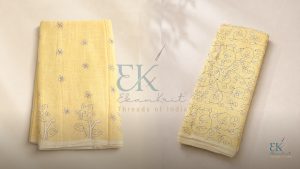
A handloom saree completely bypasses this destruction. It comes off the wooden loom as a single, uninterrupted rectangle of woven art. It is finished with selvedges on the sides and hand-tied tassels at the ends. Not a single thread is severed; not a single square inch of fabric is lost. The textile is preserved in its absolute entirety, exactly as the artisan intended.
The Infinite Silhouette
Because it is completely unstitched, a saree is never bound by the rigid constraints of clothing sizes. It does not care about fluctuating weight, aging bodies, or changing physical proportions.
A single six-yard drape can adapt to a multitude of silhouettes:
- It can be draped tightly as a classic nivi for formal elegance.
- It can be tucked into trousers for an avant-garde edge.
- It can be styled casually as a flowing sarong-style drape for summer comfort.
This fluid flexibility gives the handloom saree an incredibly long, versatile lifespan. While a tailored dress might be discarded after a few years because it no longer fits, a high-quality Modal Silk or cotton saree remains perfectly wearable across a person’s entire lifetime, shifting seamlessly with their changing body.
A Gentle Footprint
When a handloom saree eventually reaches the absolute end of its life decades later, its lack of complex stitched seams, plastic zippers, or metal buttons makes it entirely recyclable. It can be repurposed into curtains, quilts, or cushions with zero processing friction.
By embracing the unstitched handloom, we aren’t just choosing a beautiful garment—we are participating in an ancient, highly sophisticated system of circular fashion that honors the planet with every single drape.